Intact Males
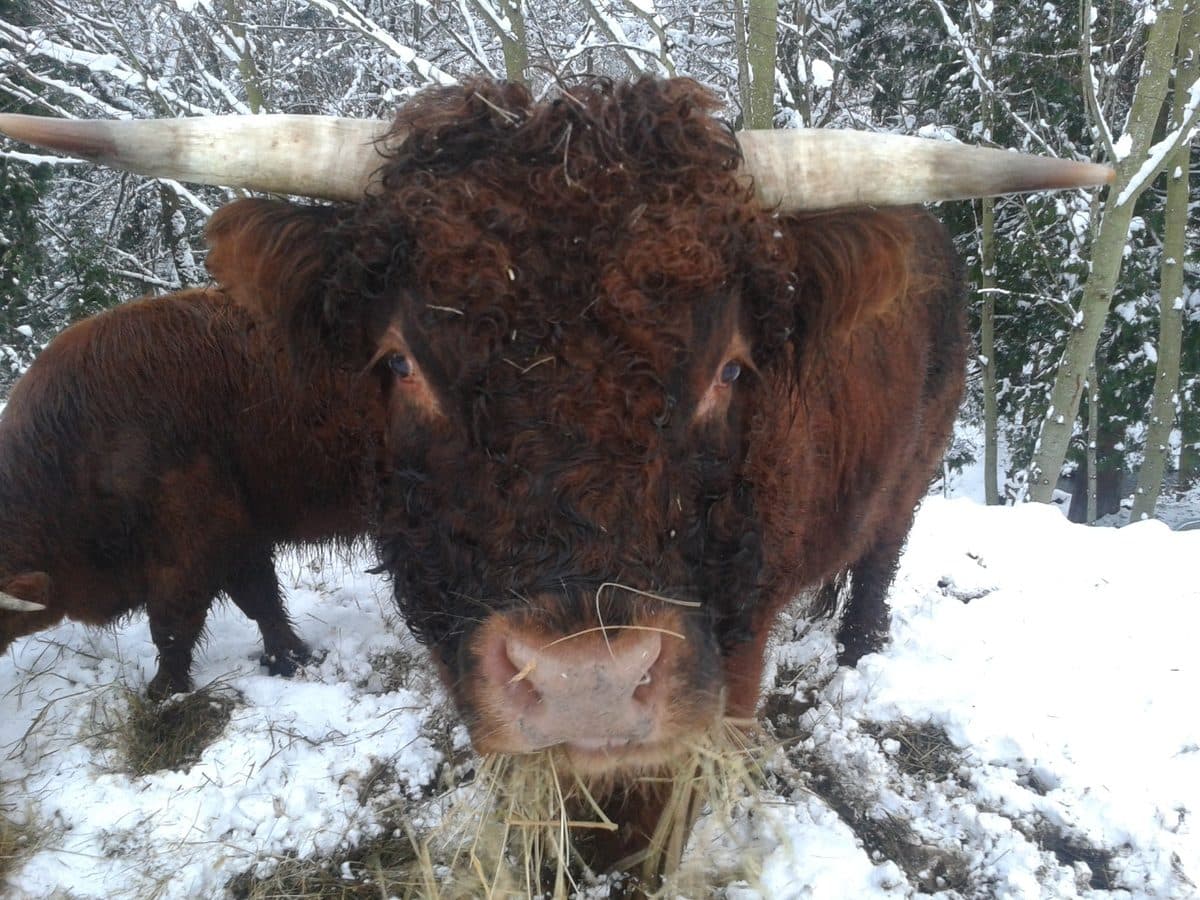
Nature seems willing to tolerate an astonishing amount of male foolishness to keep the species going.
I know this, in part, because over about ten years I raised and bred a variety of farm animals: chickens, ducks, geese, turkeys, goats, cattle, pigs, and, for about a year, even a yak. After all that time, I reached one fairly simple conclusion.
Females are much easier to live with.
I make this observation with some reluctance, since I carry a Y chromosome myself.
On the farm, that chromosome can produce some strange behavior.
Roosters and ganders can become territorial enough to attack ankles, scratch legs, and terrorize children. My poor kids were afraid to leave the house at times. We had one orange rooster in particular who seemed to make it his daily mission to stalk them around the yard. Later we had a gander nearly as tall as they were, and, truthfully, I was a little afraid of him too.
Drakes aren't especially intimidating to people, but they seem to spend nearly every waking hour relentlessly pursuing female ducks. It can become uncomfortable to watch.
Then there are tom turkeys.
Toms are probably my favorite male animals on the farm. They generally aren't frightening. They spend most of their time puffing themselves up, dragging their wings, fanning their tails, and strutting around as if the entire farm has assembled for the sole purpose of admiring them. They can also produce a deep drumming sound while they display.
Watching a tom court a hen makes it difficult to believe that human males invented the sports car independently.
As ridiculous as a tom can be, however, he still retains a certain dignity.
The same cannot be said for a buck goat.
A buck during breeding season is one of the strangest creatures I have ever encountered. He wears what can only be described as a shit-eating grin while chasing the does around the pasture. When he gets especially excited, he urinates on his own face, curls his upper lip, and appears deeply satisfied with himself.
Apparently this is courtship.
The does, meanwhile, are sweet and gentle. They smell like goats, which turns out to be perfectly pleasant until you meet a buck.
A buck can be smelled from a remarkable distance. One can stink up an entire barn. They also become large, pushy, and sometimes aggressive. I have been chased around a pasture by one more than once.
Life must be extremely committed to reproduction if this is one of the strategies it came up with.
During COVID, apparently having exhausted all sensible hobbies, I bought a bull yak.
We had Scottish Highland cattle at the time, and the idea was to breed the yak with our cows and produce some kind of interesting, lean meat animal.
The yak had other plans.
He seemed determined to make everyone miserable.
One day my ten-year-old son walked into our fenced garden, which sat inside the same pasture. The yak was nowhere around when he went in. At some point afterward, the yak appeared and stationed himself directly outside the garden gate.
My son couldn't get out.
I didn't realize what had happened for nearly an hour. Eventually I noticed him stranded inside the garden and had to use a bucket of grain to lure the yak far enough away for him to escape.
Another day my seventy-five-year-old neighbor called me.
"Your damn yak is in my yard and chasing me around. If I can get to my gun, it's going to be a dead yak."
I hurried over and found my neighbor circling a large tree with the yak following him around it.
Once again, grain saved the day.
That was enough yak ownership for me.
I called the woman I had bought him from and asked if she would take him back. She agreed. The yak evidently did not improve with age or relocation, because before long she had him processed into yak burger.
That was not the last intact male bovine to complicate my life.
A few years later I rented a Scottish Highland bull named Archie to breed our four cows.
Archie was enormous, with the long hair and sweeping horns Highland cattle are known for, but he was also remarkably calm. For about three months he lived peacefully in our pasture. I fed him apples from behind the fence, scratched his big shaggy head, and eventually became comfortable enough to walk through the field while he was there.
Then his owners brought back the trailer.
Their plan was to leave it parked by the gate for a week so Archie could become accustomed to it before they came to take him home.
Archie seemed to understand exactly what that trailer meant.
Almost immediately, his behavior changed.
He began snorting and pawing at the ground. One day I climbed over the fence to take care of something in the pasture. Archie stared at me and started scraping the dirt with his hoof.
I decided it would be wise to leave.
I was almost back to the fence when he charged.
I had never seen an animal that large move that fast.
Then again, I had never moved that fast either.
I somehow managed to get over a five-foot fence before he reached me. Archie stopped on the other side, slammed his horns into the fence, and snorted.
For the first time in three months, I had absolutely no doubt that Archie was a bull.
His owners came the next day. When I told them what had happened, they figured Archie had become rather fond of our farm, particularly the four ladies living there, and had no intention of leaving.
It took them most of the day to get him into the trailer. Grain wasn't enough. Eventually they resorted to a compressed-air horn to frighten him forward.
Once inside the trailer, he settled down again.
I spoke with his owners about a month later. They told me Archie had never returned to being the sweet, gentle giant he had once been.
He was, however, now living comfortably in several freezers as hamburger.
Farmers figured out a long time ago that intact males come with certain complications.
With cattle, goats, and yaks, one common solution is banding. A heavy rubber band is placed around the testicles, cutting off the blood supply until they eventually atrophy and fall away.
At least none of the animals ever complained to me about it.
Pigs are another matter. Castrating piglets is considerably more hands-on, and after participating in it, I can confidently say it is not an experience I need to repeat. The piglet screams as if being murdered, which, from his perspective, may not be an unreasonable interpretation of events.
Then you set him back down and, within moments, he usually wanders away and resumes ordinary pig business as if nothing happened.
I like to believe some of the screaming was theatrical.
For the record, I am recommending castration only for farm animals.
Still, after enough years around intact males, certain patterns become difficult to ignore.
The tom wants to be seen.
The rooster and the gander want territory.
The drake won't take a hint.
The buck abandons all dignity.
The bull refuses to give up what he thinks is his.
It would be comforting to believe all of this behavior belongs safely on the other side of the fence.
Unfortunately, I am male too.
I have never urinated on my own face in an attempt to attract a woman, which feels worth mentioning.
But I did once wear cheap cologne to a school dance. During a slow dance, I was fairly sure I was winning the girl over. Then she said, "Your cologne is so strong I can barely breathe."
That brought me down to size in a hurry.
In my own mind, I had smelled irresistible. I imagine the buck feels the same way.
I have bought nice clothes and flowers and worried far too much about how I looked. I have driven cars that probably said more about what I wanted people to think of me than I would have admitted at the time. I have stared into a mirror over a pimple as if my entire romantic future depended on it.
I've competed with other men when there was nothing meaningful to win and defended territory that existed mostly in my own head. More than once, I've acted differently simply because a woman I found attractive was nearby. Mostly, I have tried to look more impressive than I felt.
The methods may be more refined, but the underlying impulses don't always feel that different.
A tom turkey may look ridiculous, but at least he is honest about what he's doing.
The longer I lived around all those animals, the more impressed I became with the females. The hens, does, cows, and sows somehow endured the strutting, chasing, fighting, smelling, and general nonsense and still managed to keep the species going.
Across species, females seem remarkably patient with the males nature has assigned them.
As a male, I feel a certain gratitude on behalf of my half of creation.
Maybe the real difference between us and the animals isn't that we escaped those impulses. Maybe it is that we can recognize them, laugh at ourselves, and occasionally decide not to obey them.
The animals don't have that luxury.
And judging by how many of the intact males on my farm eventually ended up in the freezer, perhaps that's worth remembering.