For the Love of Garlic
Recently I was on vacation in British Columbia. I wasn't allowed to bring my garlic across the border.
Fifteen years of careful growing, and I was treated like a smuggler.
So, I had no choice. I had to buy foreign garlic at the grocery store.
As I put it in my cart, I looked around to make sure no one was watching. I am, after all, the Garlic Man. Nobody else calls me that, but I have a reputation to keep.
I felt like I was cheating on my wife.
Worse, I was paying for it.
When I got back to the vacation rental, I started cooking dinner and eagerly broke a bulb apart. I must confess, part of me was looking forward to examining this inferior allium. Maybe my pride was getting the best of me. I relished the moment the bulb fell open, and there in the middle was a whole cluster of tiny cloves that would take forever to peel.
I took the two largest ones, which were really pretty small as well, and chopped them up. I knew I couldn't add much more than that, since this kind of garlic tends to be hot and bitter.
Was it even worth putting any in? What exactly was it going to improve?
Oh, how I longed to get back home to the real deal.
My garlic.
In my kitchen, every meal begins with garlic. Not just any garlic. Garlic I have been growing and replanting for more than fifteen years. It is called Music, and watching those large bulbs come out of the ground as I dig them is music to my ears. And eventually to my taste buds.
But before I explain what Music means, we need to take a trip to the grocery store.
In the produce section you'll find the standard white garlic bulb we all know. It's called softneck garlic, and as far as I can tell, it comes in two varieties: bitter and tasteless.
To be fair, it has its virtues. It's readily available, it stores for a long time, and it's affordable, or cheap, as I call it. Of course, you get what you pay for. Break one apart and you'll find a crowd of teensy-weensy cloves so small that most people throw them away and use only the bigger ones. Some people skip garlic altogether because peeling these tiny wannabes that never grew up is too much work.
And where does it come from? Check the little sticker. Much of it has traveled a very long way just to disappoint you.
It's worth noting that most recipes call for two cloves of garlic. Well, which size? The tiny ones or the slightly less tiny ones? A clove is not a unit of measurement.
I suspect recipes call for so little because the authors know how hard it is to peel. And really, who wants that much hot, bitter, or tasteless garlic?
My garlic is a hardneck variety. A very large hardneck variety.
And please, please do not insult me by asking whether it's elephant garlic. I can't count how many times I've heard that from someone seeing my garlic for the first time. It may surprise you, as it surprises a lot of people, that elephant garlic isn't really garlic at all. It's a kind of leek. When you load your sauté or chili with elephant garlic, you're basically adding more onions.
It is not garlic. Just like a lingcod is not a cod.
Oh, woe to the English language.
Music garlic has five to eight cloves on every bulb, and every one of them is bigger than the biggest clove of any softneck garlic. Best of all, you can put a lot of it in a recipe without it turning hot or bitter. I usually put in an entire large bulb or more, and I barely cut the cloves. They sit in the pan like chunks of carrot or potato, and they're usually the first thing to disappear as people spear them, one after another, with their forks.
So, what does Music mean?
I'd love to tell you it was named for the sound a perfect bulb makes coming out of the ground. It wasn't. It's named after Al Music, the grower who brought it from Italy to Ontario.
Fifteen years of devotion, and it turns out I've been in love with a guy's last name.
Growing it is simple. Anyone can do it.
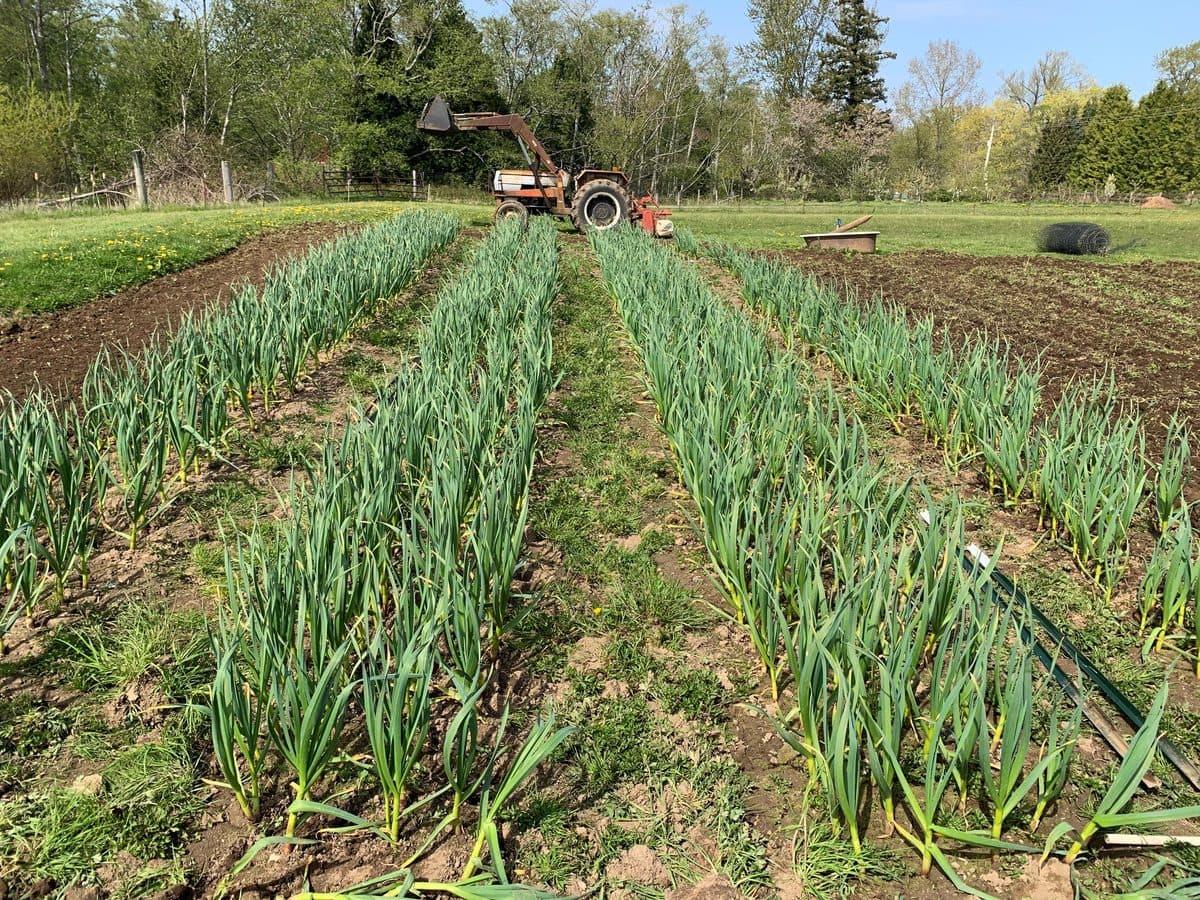
In November I rototill the ground and plant about two thousand of my largest cloves, two or three inches deep.
I don't consider this excessive.
By the end of December, little nubs push up through the soil, just in time for the January northeaster to blow through. Supposedly this garlic needs a freeze to grow properly.
There's a difference between a freeze and a really hard freeze, and when the temperature drops too far, I start worrying about what's happening underground.
Then there are the heavy rains that sometimes turn the garlic patch into a swamp. I worry about that too. And the wireworms, the weeds, and the possibility of mold.
I've been known to lose sleep over all of this.
Other than that, growing garlic is pretty simple.
By March and April, it has shot up about two feet tall. In May it's three feet, and each plant sends up a curly stalk called a scape. It's the garlic's attempt to flower.
Once the scape reaches full length, usually within a week or two, I cut it off.
If you've read my essay about the males on my farm, you may notice a pattern.
In fairness to the garlic, the scapes are delicious. I sauté them or toss them into soups. Softneck garlic generally doesn't produce scapes at all, which is one more thing it can't do.
At the end of June or the beginning of July, I dig up the whole crop and lay it out, leaves and all, to dry in the barn for about three weeks. Then I cut off the leaves and let the bulbs keep curing on wire racks. They'll last all the way until the next harvest.
Every November, I set aside the biggest, best cloves and put them back in the ground. The garlic I grow today descends from the first cloves I ever planted. I've never needed to start over.
When people see two thousand bulbs of garlic in the barn, they sometimes ask, "Why do you grow so much garlic?"
It's a reasonable question, I suppose, although I never know quite how to answer it.
Part of me wants to say, "Because I can. Why not? What's it to you?"
Another part of me wants to say, "I have absolutely no idea. I've never thought to ask myself that question. Maybe there's something wrong with me."
Usually, I just shrug.
Other people ask whether I'm trying to keep the vampires away.
"Well, not necessarily," I tell them. "But we've never had a vampire problem, so it might be working."
I recently took a road trip to Minnesota with my three sons. Naturally, I loaded up a crate of my finest garlic to take along.
My sons were slightly embarrassed as I offered garlic to nearly every relative we visited. Some looked confused when I told them I'd brought garlic to give away. Others humored me. Sometimes, when I sensed a lack of enthusiasm, I simply left a few bulbs on the counter before we departed.
Some people just don't understand.
But they eventually come around. People who had never given garlic a second thought often contact me months later asking if I have any more.
Of course I do.
By the end of our trip, I still had nearly half a crate left. Apparently, I'd overestimated the demand for garlic among my Minnesota relatives.
Fortunately, I had one more friend to visit.
He's a farmer, and unlike some of my relatives, he knew exactly what he was looking at. When I showed him the garlic, he was interested. When I told him he could plant it himself, he was even more interested.
And when I offered him the rest of the crate, he was tickled silly.
He had every intention of planting it. He knew how to do it, and I knew it was going to a good home.
He told me it was better than Christmas.
Exactly.